Evolution, Consciousness and Immortality[^0]
<Chinese version>
As biological living things, human beings have in fact fulfilled the aim of immortality through the reproductive system. However, after gradual evolution perfected the development of consciousness, each living thing (i.e. human being in this context) is aware of its own existence or alive-ness, hence besides reproducing offspring, it is natural that one would wish to be immortal. From evolution point of view, it is possible that the next step of evolution might include human's efforts to make their consciousness immortal.
To achieve an immortal consciousness is in effect to resist death. This is not a new concept as human beings have constantly employed different ways or believes to resist death since evolution gave rise to consciousness. Two prominent ways to resist death are namely: To Transcend Death and To Overcome Death. [^1]
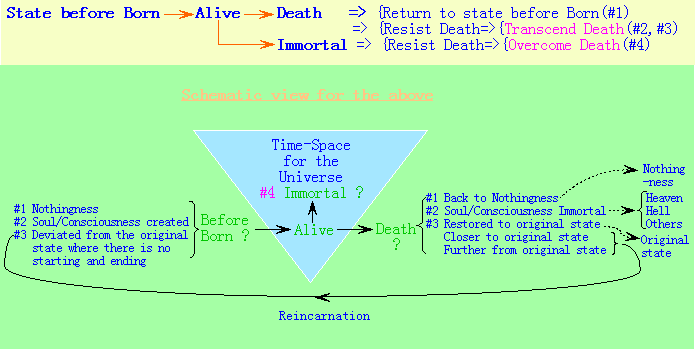
Religion believes are representatives of Transcend Death model. Through religions, human beings believe that death is not the ending, it is transcend into immortality, next life or other eternity state of beings. In other words, consciousness or soul will be immortal.
Ch'in Shih Huang of China's Ch'in Dynasty and Kings of ancient Egypt kingdoms are representatives of Overcome Death model. The former had tried to remain immortal by taking "longevity" medicines. The latter hope to be resurrected again by preserving their death bodies as mummies (?). Both had tried to overcome death but not successful.
Among the two models mentioned, the Overcome Death model is most likely to evolve further. For example, in modern times, some westerners have signed up to frozen their death bodies and hope for possible future resurrection by advance medical techniques. This is quite similar to the efforts made by ancient Egyptians. Furthermore, the possibilities of human cloning or any new advancement in genetic engineering [^2] may increase the hope of immortality, although it is not similar to immortality of consciousness.
I think the most hopeful development will have to wait until human beings are able to study and understand how human brain gives rise to consciousness. This is because without this understanding, we can not really study the meaning of "Being Alive". As an old saying has stated, "if we do not understand the meaning of being alive, how could we know the meaning of death", hence when the mechanism of [alive/consciousness] is understood, it may possibly open new ways for us to study the [death] phenomenon. In other words, in future, if we are able to study Live and Death phenomena scientifically, we might really stand the best chance to overcome death.
Of course all the above might come true only if human beings do not encounter any unbreakable limitations or disastrous. And if immortality really become an option for human beings, what will be the consequences? These are questions that need further studies and they are beyond the scope of this article.
If readers are interested to find out more about human brain and consciousness, it is better for them to hear from scientists and philosophers. The following web-site is therefore recommended.
Consciousness@ (An old web-site, year 1999, no longer valid)
Wikipedia: About the author of the above Consciousness web-site@ (Added on year 2021)
Or, for some more readings, please refer to:
The Dream and Meaning of Immortality
Reference:
- [^0]
上网日期Posted: 30/May/1999(5月30号) --- 更新日期Updated: 11/Feb/2001(2月11号) --- 草稿Draft: (原稿dd/mm/yyyy) (发稿dd/mm/yyyy, [x]) (修稿dd/mm/yyyy) (Changed to HTML5 version, added a Ref, [^0], 22-23/03/2021. NB: This article was translated from the Chinese version, more details of when and why this article was written can be found in Chinese version.)
- [^1]
There could be two major type of responses to the death phenomenon:
One type will equate Death as Returning to the state before one was born.
The other type (as mentioned in the above) will resist Death in two ways:
(a) To Transcend Death through spiritual and religious approach
(b) To Overcome Death through bio-medical and scientific approach
The following summarized these views graphically.
- [^2]
The Straits Times (16/Dec/2000)
Live to 150 years old? It may be possible
Life span of fruit flies can be doubled with gene mutation. The discovery may lead to drugs that help humans
WASHINGTON - Mutation of a gene, whimsically named 'I'm not dead yet', can double the life span of fruit flies, a laboratory discovery that researchers said may lead to drugs to help people live longer and, perhaps, even lose weight.
Researchers at the University of Connecticut Health Centre have found that the life span of fruit flies was extended from an average of 37 days to 70 days when a gene was modified on a single chromosome. Some flies in the study lived 110 days.
The same long-life gene exists in humans, said Dr Stephen Helfand, senior author of the study, and 'offers a target for future drug therapies aimed at extending life'.
In human terms, a doubled life span would be about 150 years.
Dr Helfand said the gene mutation appears to work by restricting calorie absorption on a cellular level - in effect, putting the cells on a diet. This raises the possibility, he said, of one day developing a pill that would both extend life and control weight.
'From what we know about this gene, that makes perfect sense,' he said.
He said that a key finding of the study, which appeared yesterday in the journal Science, is that not only did the fruit flies live longer, but they also seemed to maintain a high quality of life.
'It is not an empty or hollow increase in life span. It prolongs active adult life, and I think, delays the onset of ageing,' he said.
Some life-extension studies showed that animals tended to trade vigour and energy for a longer life, he said.
But the mutant flies 'do well throughout their longer life', Dr Helfand said. 'By the time that 80 to 90 per cent of normal flies are dead, these mutants are still doing fine.'
Ms Blanka Rogina, a co-author of the study, said female flies with the mutated genes were able to reproduce throughout life.
They had the energy for the complex courtship ritual and could lay up to 2,000 eggs in their lifetime, compared with about 1,300 eggs normally, she said.
The long-life gene was named for a comical line - 'I'm not dead yet' - from a Monty Python movie, Dr Helfand said.
The gene's name was suggested by co-author Robert Reenan and has been shortened to 'Indy'.
There have been other studies that found long-life genes in fruit flies and nematodes.
There also have been experiments in mice that show calorie restriction - a severe diet - can extend life by up to 50 per cent.
--AP