为什么双语政策的成功对我们很重要[^0]
这篇文章是翻译自<英文版本>
[...One abiding reason why we have to persist in bilingualism is that English will not be emotionally acceptable as our mother tongue. To have no emotionally acceptable language as our mother tongue is to be emotionally crippled. We shall doubt ourselves. We shall be less self-confident...] --- SM Lee Kuan Yew [^1]
[...我们必须坚持双语的一个持久原因是,英语在情感上将无法被我们接受为母语。没有一种在情感上可被接受的语言作为我们的母语,我们将会在情感上受挫。我们会怀疑自己。我们会变得不那么自信。...] --- 李光耀资政 [^1]
[..."We're going to change whether we like it or not. We have a better-educated population. We are more exposed to the world than ever before," he said, adding that more Singapore students and executives are travelling abroad and coming back with new ideas. "That's going to change the base," he said. "If you take other societies, like, say Japan or China, only 1 to 2 per cent of the population can surf the Internet because their English is of that level. "We have educated the whole population in English so we have no censorship." Addressing the Japanese reporter...he said: "Your censorship is the language. You would interpret only what you think is good for the balance 98-99 per cent of the population. Ours can just go surf the net -- all portals are open."...] --- (quoted from ST report) SM Lee Kuan Yew [^2]
[…“无论我们是否愿意,我们都会改变。我们的人口受教育程度更高。我们比以往任何时候都更深入的与世界接触,”他说,并补充说,越来越多的新加坡学生和高管出国旅行,带回新的想法。“这将改变(社会的)基础,”他说。“如果你看看其他社会,比如说日本或中国,只有1%到2%的人口可以上网,因为他们的英语水平就是那样。我们用英语教育了整个国家,所以我们没有审查制度。”他对日本记者说:“你们的审查制度是语言。你们只会解释你们认为对98-99%的人口有利的内容。我们可以随便上网——所有(网络)门户都是开放的。”…] --- (引述自海峡时报的报道) 李光耀资政 [^2]
[...It is the intention of the Government, through the promotion of the bilingual education policy, to enable our people to gain access to modern science and technology through the English language and preserve their cultural roots through their mother tongue to help lighten the language-learning burden on our children...] --- Mr Ong Teng Cheong [^3]
[…政府的意图是通过推广双语教育政策,使我们的人民能够通过英语获得现代科学和技术,同时通过母语保留他们的文化根源,以帮助减轻我们孩子的语言学习负担…] --- 王鼎昌先生 [^3]
The usual discussion of language, culture and identity issue in Singapore would be less contradicting and more beneficial for all if we could appreciate the importance of bilingual policy and its implications to us in nation building.
在新加坡,如果我们能够理解双语政策的重要性及其对国家建设的影响,那么我们通常关于语言、文化和身份认同问题的讨论,就会少一点矛盾及对所有人都会更有益。
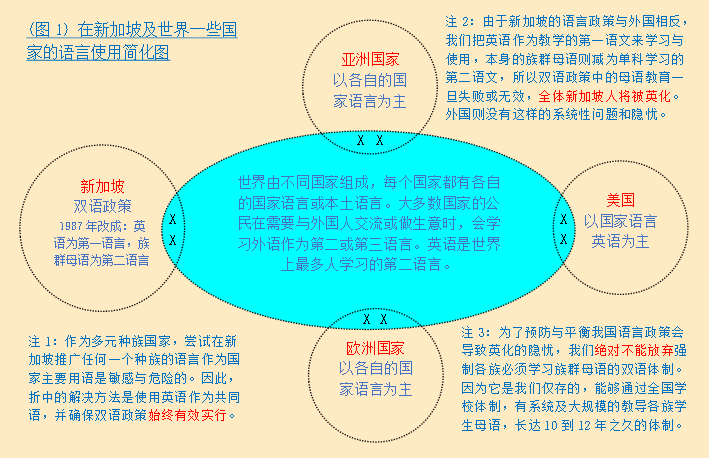
The following diagram (Fig.1) depicts a simplified view of language usage in Singapore and some country in the world. The circles represent various countries and the oval represents the world. The overlapped portion (marked with xx) between each circle and the oval represents the interaction between individual country and the world. In other words, it shows the fact that foreign languages will be learned and mastered by (some) citizens in each country whenever they are needed. Most country, especially those which are not multi-racial (proportionally speaking), naturally use their national or native language as first (1st) language to unite their people together.
以下图片(图 1)描绘了新加坡和世界上一些国家的语言使用情况的简化视图。圆圈代表各个国家,椭圆代表世界。每个圆圈和椭圆之间的重叠部分(标记为 xx)代表各个国家与世界的互动。换句话说,它表明每个国家的(一些)公民在需要时都会学习和掌握外语。大多数国家,尤其是那些不是多元种族(按比例而言)的国家,自然会使用其国家或当地语言作为第一语言来团结人民。
The circle on the left represents the multi-racial Singapore with bilingual policy.
左边的圆圈代表实行双语政策的多元种族国家新加坡。
Our bilingual policy does not simply mean English as (first)+ (1st) language, mother tongue as second (2nd) language. It contains our vision to build a united multi-racial and multi-cultural nation through the use of a common language for all races, and retaining the use of mother tongues within ethnic groups (or at least in individual family). Thus in bilingual policy, it is never ambiguous that mother tongues mean ethnic languages. It is never consider as counter Singaporean vision or identity whenever the importance of mother tongues for ethnic groups and their link to cultures and values are mentioned [^3A]. With these common understandings in mind, we can take a closer look at the important implications (i.e, advantages & disadvantages) of our bilingual policy.
我们的双语政策不仅仅意味着英语作为第一语言,母语作为第二语言。它包含了我们想通过,让所有种族使用一种共同语言,以及保留各族母语在各个族群中的使用(或至少在每个家庭中使用),来建立一个团结的多种族和多文化国家的愿景。因此,在双语政策中,母语指的就是族群语言,这一点从不含糊。每当我们提到母语对族群的重要性及其与文化和价值观的联系时,这从未被视为与新加坡的愿景或身份认同相违背 [^3A]。有了这些共同的理解为基础,我们就可以更仔细地看看我国双语政策的重要含义与影响(即优点和缺点)。
From the attached diagram, although it can be said that the globalisation (which include
modernisation and industrialisation) has further enhanced English as the most learned 2nd
language in the world, but it has not changed a simple fact, that is, most country have remained localise in term of language (education)+. Their populations
are first rooted or shielded with local languages and thus with stronger and lasting
influences by local cultures and values before exposing to foreign languages. This (language education)+ approach is more (conservative) (standard)+ and
although it is (not suitable for us) (not use by us)+, but since it is practiced by most country in the world, it would be beneficial for us to understand its
merit. [^4]
从附图可以看出,尽管可以说全球化(包括现代化和工业化)进一步增强了英语作为世界上最常被学习的第二语言地位,但这并没有改变一个简单的事实,即大多数国家在语言(教育)+方面仍然保持本地化。他们的人口首先扎根于本地语言或受到本地语言的保护,因此在接触外语之前,他们会受到本地文化和价值观的更强和更持久的影响。这种(语言教育)+方法比较(保守)(标准)+,尽管(它不适合我们)(我们没有使用它)+,但由于世界上大多数国家都在应用这个方法,因此了解其优点对我们是有益的。[^4]
The advantage for most country to use local or native language as first language is obvious.
For majority of their citizens that do not know or have just acquired basic level of
foreign languages through 2nd language education, unwanted foreign influences through
globalisation will be limited or superficial. For their elite and those citizens who have
mastered foreign languages, they will be truly bilingual; [^5]
thus foreign influences are less likely to predominate their views while helping them to
see the world in another perspective. In fact as the overlapped portions of the attached
diagram have suggested, citizens who are bilingual usually could act as middlemen to
introduce and translate foreign knowledge, cultures and values to their local citizens.
Therefore, although no country in the world will be able to avoid western
influences (through globalisation) (while going through globalisation)+, but with stronger attachment to local language and
culture, most country can maintain their uniqueness and modernise without westernise.
对大多数国家而言,使用本地语言或母语作为第一语言的优势是显而易见的。因为对于他们多数不懂外语,或仅通过第二语言教育掌握了基础外语水平的公民来说,通过全球化(而受到)不良的外来影响将是有限的或表面的。对于他们的精英和那些掌握外语的公民来说,他们将是真正的双语人士;[^5] 因此,外来影响在帮助他们从另一个角度看世界的同时,不太可能会完全主导他们的观点。事实上,正如附图中重叠的部分所显示的,双语公民通常可以充当中间人,将外国的知识、文化和价值观介绍和翻译给本地公民。因此,尽管世界上没有任何国家能够(通过全球化)(在经历全球化时)+避免受到西方的影响,但由于对本地语言和文化的更强依附,大多数国家可以保持其独特性,并在不西化的情况下实现现代化。
As a multi-racial nation facing numerous limitations and constraints (in survival and governance conditions)+, our language policy has
evolved differently from others. Since 1987, English has become the 1st language and
mother tongue the 2nd language in our bilingual policy. In other words, our language
education is much less localise than most country (i.e. we are doing the opposite way the other countries are doing)+. The important implications of this
differen(ce) are obvious. With English as 1st language, it can
better fulfill our vision to build a united nation base(d) on justice and equality for all
races. Its economic value is also important for us (as it can help us)+ to link and compete globally. However,
on the other hand, instead of providing us a shield, (it) (the use of English as 1st language)+ has exposed us, the entire nation, to all kind of western
influences [^6] directly and dominantly
--- if we do not make any effort to balance them. Therefore
the success and effectiveness of our bilingual education has become very important to us
in nation building. For if we fail, we are more likely to westernise than other countries. [^7]
作为一个(在生存和治理条件方面)+面临诸多限制与制约的多元种族国家,我们的语言政策发展方向与其他国家不同。自1987年以来,在我们的双语政策中,英语已经成为第一语言,母语则是第二语言。换句话说,我们的语言教育本地化的程度比大多数国家要低的多 (即,我们的做法与外国相反)+。这种差别的重要含义是明显的。以英语作为第一语言,它可以更好地实现我们为各族建立一个基于正义和平等的,团结的国家愿景。它的经济价值对于我们也很重要,因为它可以帮助我们在全球范围内建立联系和竞争。然而,另一方面,与其为我们提供一个保护层,(它)(使用英语为第一语言)+会直接及主导性的将我们整个国家暴露于各种西方影响[^6]之下——如果我们不做出任何努力来平衡它们的话。因此,我国双语教育的成功和有效性在我们的国家建设中就变得非常重要。因为如果我们失败了,我们比其他国家更有可能西化。[^7]
Hence the main concern is how to enhance and assist bilingual education so that we can maintain a balance of eastern and western influences for our younger and future generations. The idea to consciously promote our languages, cultures and values as a counter-balancing effort to the silent western influences on our young is therefore necessary. It is a pragmatic approach to supplement bilingual education so that more of our young will remain bilingual and culturally balance even though they are more proficient in English than mother tongues.
因此,问题的主要关注点是该如何加强和协助双语教育,以便我们能够为年轻一代和后代子孙保持东西方影响的平衡。所以,我们想通过有意识地推广我们的语言、文化和价值观,来作为一种平衡西方文化对年轻人无声影响的努力,是有必要的。这是一种补助双语教育的务实方法,以便我们会有更多年轻人能够保持双语能力和文化平衡,即使他们更精通的是英语而不是母语。
Unfortunately all the conscious promotions of eastern cultures and values are more difficult than the silent influences that our young are continuously receiving from the west (through good command of English), especially ours is a multi-racial society. Therefore most of our balancing efforts are seen by critics as negative developments to Singapore culture and identity because, in order to be fair, we have to consciously promote different ethnic cultures and values for different races. It thus seems that we are stressing ethnic differences rather than building common values for all (This is a typical example, which shows one of the limitations of using conscious promotions to counter-balance the power of silent influences. Another limitation is continuous conscious promotions will encounter fatigue effect, thus after certain point, the receiving parties may treat any such promotions as routine "lecturing" and might ignore them. Furthermore, public promotions of one's values might offend any affected parties and cause mis-understandings or resentments if not handle sensitively.) [^8].
不幸的是,所有有意识地推广东方文化和价值观的努力,都比我们的年轻人不断从西方接受的无声影响(通过熟练掌握的英语)要困难得多,尤其是在我们这个多元种族社会。因此,我们所做的大多数平衡努力都被批评者视为是对新加坡文化和身份认同的负面发展,因为为了公平起见,我们必须有意识地为不同种族推广不同的民族文化和价值观。因此,我们似乎是在强调种族差异,而不是为所有人建立共同的价值观。(这是一个典型的例子,显示了使用有意识的推广来平衡无声影响力的局限性之一。另一个局限性是持续的有意识推广会遇到疲劳效应,因此在某个时间点之后,接受方可能会将任何此类的推广视为例行“说教”并可能忽略它们。此外,如果处理不当,公开宣传自己的价值观可能会冒犯任何受影响的一方并引起误解或怨恨。)[^8]
But these are no contradiction, we are a multi-racial nation, preserving of ethnic languages, cultures and values is thus a natural part of our multi-racialism and multi-culturalism. They are part of Singapore culture, which form the eastern bases of our society. Therefore as far as this part of Singapore culture’s development is concern, what has been changed is that instead of silent influences that we used to (when we are more proficient in mother tongues), we are turning to more conscious promotion to ensure our young are given enough exposure to eastern cultures and values. It is not about racial hegemony or communal politic. Neither it is aim to resist western influences blindly [^9].
但这些并不矛盾,我们是一个多元种族国家,因此保留各种族的语言、文化和价值观是我们的多元种族主义和多元文化主义的自然组成部分。它们是新加坡文化的一部分,构成了我们社会的东方基础。因此,就这一部分的新加坡文化的发展而言,已经发生的变化是,我们不能再像以前那样通过无声的影响(当我们更精通母语时),而是转向更有意识的推广,以便确保我们的年轻人有足够的机会接触东方文化和价值观。这不是搞种族霸权或族群政治,也不是要盲目抵制西方的影响。[^9]
On the other hand, with the successful implementation of common language and the common experiences we continuously going through in nation building, we believe the development of Singapore culture will evolve beyond the bases of preserving our eastern cultures and values. New social, cultural and political ingredients will be developed and added gradually to enrich and expand our multi-culturalism. They will form and strengthen the localise bonds and identity of our society.
另一方面,随着共同语言的成功实施以及我们在国家建设中不断经历的共同经验,我们相信新加坡文化的发展将超越保留我们东方文化和价值观的基础。新的社会、文化和政治元素将逐步发展和加入,以丰富和扩展我们的多元文化主义。它们将形成及巩固我们社会的本土化纽带和身份认同。
Our language policy may look odd to foreigners, but it is as important as theirs is in nation
building. It has provided us a constructive framework to preserve and enrich our
multi-culturalism so that the new Singapore culture will emerge from it. Therefore as long
as the bilingual vision we have for Singapore prevail (can prevail and materialise)+, the "less localise
nature" of our language policy will not turn us into another "red dot" on the map (in Asia) [^10].
我们的语言政策在外国人看来可能有些奇怪,但在国家建设中,我们的语言政策与外国人的语言政策是一样重要的。它为我们提供了一个建设性的框架,以便保留和丰富我们的多元文化主义,从而使新的新加坡文化能从中诞生。因此,只要我们对新加坡的双语愿景占上风(能占上风及得到实现)+,我们语言政策的“非本地化性质”就不会使我们变成(在亚洲)地图上的另一个“红点”。[^10]
Postscript: Some history of this article [^11]
以下为本文的注解(Ref):
- [^0]
上网日期Posted: 27/Sep9月/2000(9月27号) --- 更新日期Updated: 11/Feb2月/2001(2月11号), 25/Sep9月/2024(9月25号) --- 草稿Draft: (原稿dd/12/1998) (发稿07/01/1999, [x]) (修稿27/09/2000) (ChangedTo改成HTML5版本, AddedRef添加注解[^0],[^3A],[^11], TranslatedToChinese翻译成中文, 03-25/09/2024)
From 03-25/Sep/2024, had translated the English article that I have put online since 27/Sep/2000 into Chinese using Google Translate and Mircosoft Copilot. The diagram (Fig 1) in the English version was also translated into Chinese. During the translation, some minor changes were also made to the English artice, the changes were denoted by(deleted删除)and (added添加)+ symbols. The diagram (Fig 1) was also slightly edited.
从03-25/09/2024,笔者借助谷歌翻译Google Translate和微软Microsoft的Copilot将我在27/09/2000年放上网的英文文章翻译成中文,同时也根据稍做修改后的英文版本(Fig 1)制作了(图 1)。在翻译的过程中也对英文文章做了一些改动,并用(deleted删除)和 (added添加)+ 符号做了标记。
- [^1]
Ref: Book, <<华人 华语 华文 Mandarin: The Chinese Connection>>
Published By: Promote Mandarin Council
Call Number: Lee Kong Chian Reference Library Level 9, 306.4495957 MAN
Pg 164 --- SM Lee Kuan Yew
[...One abiding reason why we have to persist in bilingualism is that English will not be emotionally acceptable as our mother tongue. To have no emotionally acceptable language as our mother tongue is to be emotionally crippled. We shall doubt ourselves. We shall be less self-confident...]
参考:书本,《华人 华语 华文 Mandarin: The Chinese connection》
出版:新加坡,推广华语理事会,2000年
编号:国家图书馆总馆 Lee Kong Chian Reference Library Level 9, 306.4495957 MAN
Pg 164 --- 李光耀资政 --- (注:这是自语区提供的中译版本)
[...我们必须坚持双语的一个持久原因是,英语在情感上将无法被我们接受为母语。没有一种在情感上可被接受的语言作为我们的母语,我们将会在情感上受挫。我们会怀疑自己。我们会变得不那么自信。...]
- [^2]
From Senior Minister Lee Kuan Yew's answer to a question on political changes (such as the introduction of Speakers' Corner) raised by a Japanese reporter. For more detail, please refer to: The Straits Times (15/Sep/2000, pg 61) <<SM LEE'S PRESS CONFERENCE ON HIS MEMOIRS>>
[..."We're going to change whether we like it or not. We have a better-educated population. We are more exposed to the world than ever before," he said, adding that more Singapore students and executives are travelling abroad and coming back with new ideas. "That's going to change the base," he said. "If you take other societies, like, say Japan or China, only 1 to 2 per cent of the population can surf the Internet because their English is of that level. "We have educated the whole population in English so we have no censorship." Addressing the Japanese reporter...he said: "Your censorship is the language. You would interpret only what you think is good for the balance 98-99 per cent of the population. Ours can just go surf the net -- all portals are open."...]
摘自李光耀资政对一位日本记者关于政治变革(如设立演说者角落)的提问的回答。详情请参阅:《海峡时报》(2000年9月15日,第61页)《李资政回忆录新闻发布会》。
(注:这是自语区提供的中译版本)
[…“无论我们是否愿意,我们都会改变。我们的人口受教育程度更高。我们比以往任何时候都更深入的与世界接触,”他说,并补充说,越来越多的新加坡学生和高管出国旅行,带回新的想法。“这将改变(社会的)基础,”他说。“如果你看看其他社会,比如说日本或中国,只有1%到2%的人口可以上网,因为他们的英语水平就是那样。我们用英语教育了整个国家,所以我们没有审查制度。”他对日本记者说:“你们的审查制度是语言。你们只会解释你们认为对98-99%的人口有利的内容。我们可以随便上网——所有(网络)门户都是开放的。”…]
- [^3] [^3A]
Ref: Book, Same as [^1]
Pg 165 --- Former Elected President, Mr Ong Teng Cheong.
[...It is the intention of the Government, through the promotion of the bilingual education policy, to enable our people to gain access to modern science and technology through the English language and preserve their cultural roots through their mother tongue to help lighten the language-learning burden on our children...]
参考:书本,同上[^1]
Pg 165 --- 前民选总统王鼎昌先生 --- (注:这是自语区提供的中译版本)
[…政府的意图是通过推广双语教育政策,使我们的人民能够通过英语获得现代科学和技术,同时通过母语保留他们的文化根源,以帮助减轻我们孩子的语言学习负担…]
- [^4]
As most country understand the benefits of using English to communicate with the rest of the world and to enhance their competitive advantage, therefore they are likely to incorporate English as the second language in their education. And as usual, only a certain percentage of their populations who can cope with and need to use two languages will become truly bilingual, majority of their populations will acquire basic level of English. This is a pragmatic approach in the globalised world for most country.
由于大多数国家都理解使用英语与世界其他国家交流和提高竞争优势的好处,因此他们很可能将英语作为第二语言纳入他们的教育中。而且通常在这些国家,只有一小部分能够应付并需要使用两种语言的人口会真正成为双语者,而大多数人口将掌握基本水平的英语。这是全球化世界中大多数国家的一种务实做法。
- [^5]
Ref: Book, Same as [^1]
Pg 14 --- Prime Minister, Mr Goh Chok Tong.
[... If you go to Taiwan, you will find that the people at the top are effectively bilingual in English and Mandarin. They can switch in and out. It is a high level of proficiency...]
An important question to ask is whether under our bilingual education, do majority of our elite acquire high level of bilingual literacy? It is believed that the more elite and people we have are effectively bilingual, the more likely the bilingual vision we have for Singapore will success.
参考:书本,同上[^1]
Pg 14 --- 吴作栋总理 --- (注:这是自语区提供的中译版本)
[...如果你去台湾,你会发现他们的高层人士在英语和华语方面都非常流利。他们可以自由切换。这是一种高水平的语言能力...]
一个重要的问题是,在我们的双语教育下,我们的大多数精英是否能获得高水平的双语能力?我们相信,有越多精英和人民有效掌握双语,我们对新加坡的双语愿景就越有可能成功实现。
- [^6]
Probably most western influences are likely to come from USA. And with these influences, a point to ponder upon is that besides new immigrants, most Americans are basically mono-lingual since they need not learn others' languages, will this affect how they view the world and in turn influenced the rest to see the world in that perspective?
大多数的西方影响很可能都来自美国。而在这些影响下,一个值得思考的问题是,除了新移民外,大多数美国人基本上是单语的,只会说一种语言,因为他们不需要学习其他语言,这会影响他们如何看待世界,并反过来影响其他人以这种视角看待世界吗?
- [^7]
Ref: Book, Same as [^1]
Pg 168 --- Deputy PM, BG Lee Hsien Loong.
[...As we become a modern industrial economy, we must not lose our cultural heritage, and become a pseudo-Western society. Language has a considerable part to play. Knowledge of the mother tongue gives us a much stronger sense of identity and belonging...]
参考:书本,同上[^1]
Pg 168 --- 副总理李显龙准将 --- (注:这是自语区提供的中译版本)
[...随着我们成为现代工业经济体,我们绝不能失去我们的文化遗产,变成一个伪西方社会。语言在其中起着相当重要的作用。对母语的了解使我们有更强的身份认同感和归属感。...]
- [^8]
Sometimes those who felt offended might voice their views in newspaper's forum page. The following is one example from Straits Times and the responses from two other readers.
有时那些感到被冒犯的人可能会在报纸的论坛页面上表达他们的观点。以下是《海峡时报》上的一个例子,以及另外两位读者的回应。
NB: 若有需要翻译以下文章,读者可用 (a) 谷歌翻译Google Translate 或 (b) 微软Microsoft的Copilot
Hypocritical to condone racism against Caucasians I REFER to the letter, ""Revive religious faith among young to check moral decline'' (ST, Oct 30).
I make no comment on the writer's views regarding religion, as that is not the concern of this letter. But he made some remarks against Caucasians that were both racist and insulting.
I have lived and worked here for five years, and comments such as ""we are fighting a losing battle against the onslaught of decadent Western values'' are, quite frankly, offensive.
Now, the debate about ""Asian/Western'' values has had copious amounts written about it, and it is a tired old horse, so let us leave it in the stable.
I simply wish to state that when someone in Australia makes bigoted, ignorant, simplistic and racist remarks, that person is labelled correctly as an ignorant racist. One such example was Ms Pauline Hanson. When she made remarks against Asians, she was justly vilified throughout Asia, and also by the vast majority of Australians.
From the earlier quotation, one can infer that in the writer's eyes, Westerners (ie. Caucasians) are morally bankrupt, decadent and in some way inferior to Asians. This is known as racial stereotyping.
Why is it then that bigoted remarks against Caucasians are regarded as decent and acceptable here? The answer: gross hypocrisy.
John A. Douglas (ST 01/Nov/2000, Forum Page)
West has to be sensitive to Asians too THANK you, Mr John Douglas, for reminding us of how we can be more sensitive culturally to the West, ("Hypocritical to condone racism against Caucasians''; ST, Nov 1).
On the evening before his letter was published, I opened a copy of James Clavell's book, Taipan, knowing fully well what to expect.
The opening chapters described Commissioner Lin Tse Hsu's blockade to force the surrender of narcotics by smugglers as an act against ""defenceless traders''.
The war in 1840 was blamed on Chinese laws curtailing contact and trade with the West, written as if these were ample justification for war, then and even now.
Not a word about the moral reprehensibility of the narcotics trade, nor the superciliousness then affected by Caucasians when dealing with Asians.
Indeed, there was not, on the shelves, a Western work of fiction set in historical or contemporary Asia which did not purvey slanted, bigoted and stereotypical views of Asia and Asians.
To dismiss these works as pulp fiction skirts the question: ""What does it say about Western receptiveness towards such views that they should become mainstream in the Western popular media?''
Mr Douglas finds negative Asian references to Western ""values'' sweeping and offensive. His solace is in being able to empathise with those Asians who are offended through daily contact with the Western media.
Wong Hoong Hooi (ST 02/Nov/2000, Forum Page)
Foolish to over-react to remarks against Western values I THINK Mr John Douglas (""Hypocritical to condone racism against Caucasians''; ST, Nov 1) over-reacted to the term ""decadent Western values''.
If those who bandy this term about, like I do occasionally, understand that some Western values are actually good, moral, honourable and supportive of the family, then no offence should be taken.
Some Singaporeans may be surprised to learn that for most of its history, the US was a strictly moral society, and that its colonial founders held to standards enforced by law that would have made Singapore in the 1970s, in comparison, look like Las Vegas. But those are not the values being projected to the world through Hollywood.
Similarly, there are decadent Asian values too. But the suppression of these ""values'' and the adoption of the better Asian values helped most of East Asia develop. I believe the writer Mr Douglas was responding to was correct to stress the need for religion to strengthen the best values (whether Asian or Christian) and discourage the truly decadent Western values.
It is foolish to be so sensitive to people's often-irrational feelings that we fail to identify and guard against the invasion of Hollywood's propaganda.
John B. Carpenter (ST 03/Nov/2000, Forum Page)
Comment 1: A well known fact in Singapore is that our leaders and most Singaporeans have constantly stressed the importan(ce) of bilingual education and Asian values publicly since independen(ce). All these are our responses aimed to balance any social and cultural changes to our society after using English as main official language. Despite limitations mentioned, conscious promotion is still the best method for counter-balancing western influences under our situation. Perhaps we should learn to be more tactful so that any side-line debates on Asian/Western values would not distract our attention from the main social-cultural challenges we might need to face when all Singaporeans become English educated.(Will)(By then,)+ (will)+ Singaporeans(then)(still)+ support bilingual policy and promotion of Asian values(?)+ (That)+ will certainly determine how successful we have been in building a balanced east-west society.
Comment 2: If foreigners, permanent residents and new immigrants have opportunities to understand the background of the social-cultural challenges that we are facing, then there should be less chances for mis-understanding to occur.
评论 1:在新加坡,一个众所周知的事实是,自独立以来,我们的领导人和大多数新加坡人都一直在公开强调双语教育和亚洲价值观的重要性。所有这些都是我们在使用英语作为主要官方语言后,为了平衡社会和文化变迁所做的回应。尽管存在已知的局限性,但在我们的情况下,有意识的推广仍然是抵消西方影响的最佳方法。也许我们应该学会更技巧些,以便任何关于亚洲/西方价值观的边缘辩论,不会分散我们对所有新加坡人都接受英语教育后,可能需要面对的主要社会文化挑战的注意力。到那时(指新加坡人都接受英语教育后),新加坡人还会支持双语政策和亚洲价值观的推广吗?这无疑将决定我们在构建东西方平衡社会方面的成功程度。
评论2:如果外国人、永久居民和新移民有机会了解我们所面临的社会文化挑战的背景,那么发生误解的可能性就会降低。
NB: 若有需要翻译以下文章,读者可用 (a) 谷歌翻译Google Translate 或 (b) 微软Microsoft的Copilot
The following is the letter that prompted the above discussion in Straits Times Forum pages. Revive religious faith among young to check moral decline
I REFER to the letter, ""Teach young the value of chastity'' (ST, Oct 27).
I understand the writer's concerns over the decline of morality and his call for renewed attention to the value of chastity.
But I feel that asking for the return of Victorian-like morality is insufficient.
We must bear in mind that the problems our teens are facing now have evolved out of the gradual liberalisation of our society.
Increased exposure to Western values has culminated in the indiscriminate emulation of these values by our young.
Rising secularisation has witnessed a corresponding decline in one of the moral ""safeguards'' of our society -- religion.
Hence, there is a soaring proliferation of atheism among the populace, resulting in a ""spiritual vacuum'' that is being filled by materialism and the pursuit of sensual pleasures.
During the time of our forefathers, religious affiliation and conviction ensured that one would not stray from the beaten path, for fear of incurring the wrath of one's god and suffering retribution in the after-life.
Strong beliefs and fear of the unknown became the best form of deterrence then.
In the present situation, we are trying to substitute the difficult role religion plays with programmes like sex education.
The increase in abortions indicates that we are fighting a losing battle against the onslaught of decadent Western values.
Besides introducing sex education, I strongly suggest that the Education Ministry consider enhancing the teaching of religious or moral studies in our schools.
1 The authorities, civil institutions and media can also do their part by focusing on the importance of religious celebrations by our different racial groups and increasing their prominence in the eyes of our young.
Although our Constitution guarantees the freedom of beliefs and associations, I strongly believe that we can arrest the undesirable trends among our young if we can restore their faith in religion.
Xie YanMing (ST 30/Oct/2000, Forum Page)
- [^9]
In one of the debate on ST forum page in 1999 about the Changes to teaching of Chinese Language in school, an English-educated Singaporeans has pointed out the following:
在1999年(海峡时报)ST论坛页面上关于学校华文教学改革的辩论中,一位受英语教育的新加坡人指出了以下几点:
NB: 若有需要翻译以下文章,读者可用 (a) 谷歌翻译Google Translate 或 (b) 微软Microsoft的Copilot
<The Straits Times> Jan 29 1999 A problem of culture
ADJUSTMENTS to the teaching of Chinese as a second language can only alleviate or compound the difficulties of English-educated Chinese. The problem is still cultural.
It requires conscious effort to value one's heritage and ethnicity, of which learning one's own language is definitely a part, in an environment that is predominantly Western influenced.
To deny the need by reciting that "values are universal" is a poor excuse at best. Culture, ethnicity, identity and perspective are definitely not universal, and these are the real issues. To say that there are Westernised Chinese even in China misses the point.
No one claims a fail-safe counter to Westernisation or wants Western influence excluded. Rather, the aim is to help the individual build a Chinese Singaporean cultural core to manage the West's influence.
Far from being debunked as myth, it is what every culture which has retained its identity successfully while benefiting from contact with the rest of humanity has done.
Learning Chinese as a second language is no guarantee of cultural integrity, but abandoning one's own language is a fundamental psychological break from one's culture that guarantees further cultural loss in future. It is a delusion that marginalising ethnicity develops a culturally neutral perspective when Western influence is so pervasive. What we do or fail to do today indeed determines our culture of tomorrow.
That some English-educated Chinese Singaporeans prefer emigration to having their children struggle with Chinese in school speaks volumes about the damage wreaked on our psyche by Westernisation.
With an aversion to one's own language and culture, talk of cultural transcendentalism and multiculturalism is perverse. These become pretensions to disguise cultural abandonment.
Chinese in Hongkong and Taiwan read Chinese as a first language, even if they prefer speaking their dialects. Without English as a first language, they still produce Western tertiary graduates, entrepreneurs and innovators.
If anything, they are seen as more vibrant than the English-speaking Chinese Singaporean who complains that having to study Chinese hampers personal development.
Worse, we affect a false superiority over fellow Asians for our having a proficiency in English bought at the cost of de-culturalisation.
Those who have called for ethnic rediscovery and renewal are fully vindicated.
WONG HOONG HOOI
- [^10]
(A former)(Formal)+ Indonesia President, Dr BJ Habibie, had pointed out that Singapore is just a red dot on the map, meaning, it is a very small and insignificant country. The use of red-dot here, however, means, not the special, but the odd one. We will be at odd with all Asians (and probably with most people in the world, including the English speaking people in the west) if our future generations are mostly proficient in English but look down on or hated our own (Asian based) ethnic languages and cultures.
印尼前总统哈比比博士曾指出,新加坡只是地图上的一个红点,意思是它是一个非常小及无关紧要的国家。然而,这里使用“红点”一词的意思,表示的,不是特别的,而是奇特的、格格不入的。因为如果我们的后代子孙大多精通英语,却看不起或憎恨我们自己(亚洲人)的民族语言和文化,那么我们将与所有亚洲人(可能还包括世界上大多数人,以及讲英语的西方人)显得格格不入。
- [^11]
Postscript: Some history of this article
The following article, titled "Language, culture, identity and bilingual policy", with a diagram, were drafted around Dec/1998 and faxed to (The Straits Times) ST forum desk on 07/Jan/1999. They were not published so I amended them, re-named the title to "Why the Success of Bilingual Policy is Important to Us", and put online on 27/Sep/2000. Recently (Sep/2024), I have decided to translate the article and diagram to Chinese, thus besides putting the Chinese version 《为什么双语政策的成功对我们很重要》 online, I think it is better to put the original 07/Jan/1999 English version online too.
后记:关于本篇文章的一点历史
以下文章 "Language, culture, identity and bilingual policy" 和图表是在1998年12月左右起草的,并于1999年1月7日传真到(海峡时报)ST论坛办公室。它们没有被发表,所以我修改了它们,将标题改名为 "Why the Success of Bilingual Policy is Important to Us" ,并于2000年9月27日放上网。最近(2024年9月),我决定将文章和图表翻译成中文,因此除了将中文版《为什么双语政策的成功对我们很重要》放上网外,我认为最好也将1999年1月7日的原始英文版本也放上网。
07/Jan/1999
Language, culture, identity and bilingual policy
The recent discussion of language, cultural and identity issue in Singapore will be clearer and less contradicting if we touch on and “look at” our language policy and its implication.
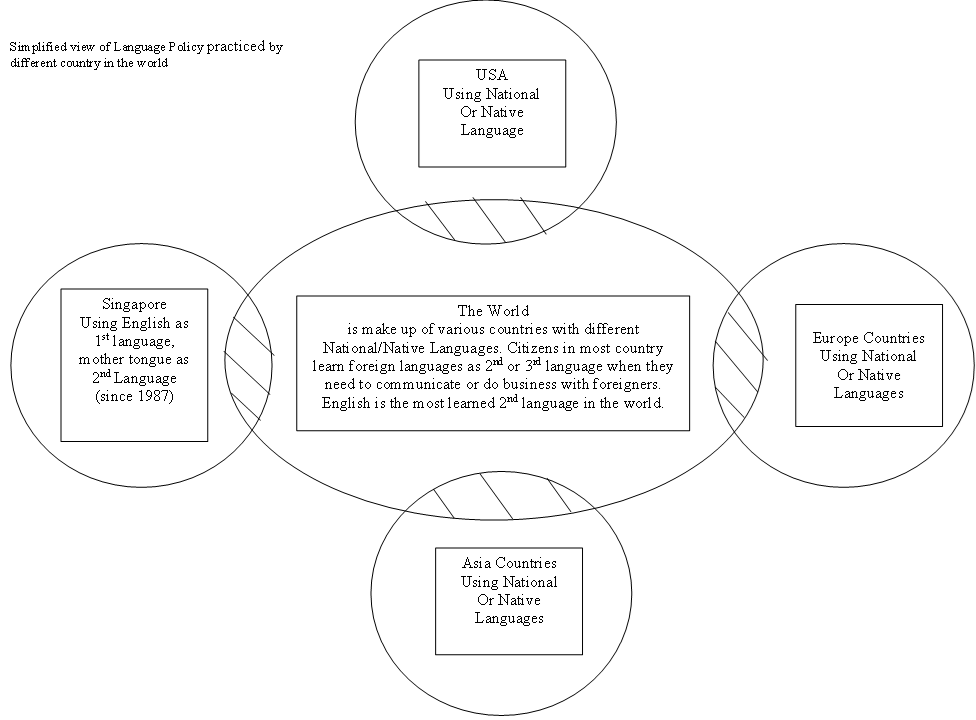
The attached diagram depicts a simplified view of language policy practiced by different country in the world. The circles represent countries and the oval represents the world. The shaded portion between each circle and the oval represent the interaction between individual country and the world. In other words, it shows the fact that foreign languages will be learned and mastered by some citizens in each country when needed. Most country naturally uses their national or native language as 1st language to unite their people.
The circle on the left represents Singapore, it is clear that our language policy is different from others. Although this has important implication that we will discuss later, it does not mean that our policy is wrong. In fact, there are many important considerations and advantages which made most of us believe that it is the best policy we can afford to pursue under our situation to unite Singaporeans together.
Our language policy (or best known as bilingual policy) does not simply mean English as 1st language, mother tongue as 2nd language. It contains our vision to build a united multi-racial and multi-cultural nation through the use of a common language for all races, and retaining the use of mother tongues within ethnic groups (or at least in individual family). Thus in bilingual policy, it is never ambiguous that mother tongues mean ethnic languages. It is never consider as counter Singaporean vision or identity whenever the importance of mother tongues for ethnic groups and their link to cultures and values are mentioned. With these in mind, let us “look at” the important implication of our language policy.
From the attached diagram, it is clear that although the globalisation (including modernisation and industrialisation) may have made English becomes the most learned 2nd language in the world, but it has not change a simple fact that most country remain localise in term of language. They are first rooted or shield with local language and thus with local culture and value before exposed to foreign languages. This may sound sensitive to some Singaporeans but it is important for us to know that this is what most country in the world, which we do business with, is practicing.
The advantage for most country to use local or native language as their first language is obvious. For majority of their citizens that do not know or have just acquired basic level of foreign languages through 2nd language education, unwanted foreign influences through globalisation will be limited or superficial. For their elite and those citizens who have mastered foreign languages, they will be truly bilingual; thus foreign influences are less likely to predominate their views while helping them to see the world in another perspective. In fact as the shaded portions of the attached diagram have suggested, citizens who are bilingual usually can act as middlemen to introduce and translate foreign knowledge, cultures and values to their local citizens. Therefore although no country in the world will be able to avoid western influences through globalisation, but with strong attachment to local language and culture, most country can preserve their uniqueness and modernise without westernise.
As a multi-racial nation facing numerous limitations and constraints, our language policy has evolved differently from others. Since 1987, English has become the 1st language and mother tongue the 2nd language in our bilingual policy. In other words, we are doing the opposite way the other countries are doing in language education. The important implication of this different is clear. With English as 1st language, it can better fulfill our vision to build a united nation base on justice and equality for all races. Its economic value is also important for us to link and compete globally. However, on the other hand, instead of providing us a shield, it has exposed us, the entire nation, to all kind of western influences directly and, dominantly -- if we do not make any effort to balance them. Therefore the success and effectiveness of our bilingual education has become very important to us in nation building. For if we fail, we are more likely to westernise than other countries.
Hence the main concern is how to enhance and assist bilingual policy so that we can maintain a balance of eastern and western influences for our younger and future generations. The idea to consciously promote our language, culture and value as a counter-balancing effort to the silent western influences on our young is therefore necessary. It is a pragmatic approach to supplement bilingual education so that more of our young will remain bilingual and culturally balance even though they are more proficient in English than mother tongue.
Unfortunately all the conscious promotions of eastern cultures and values are more difficult than the silent influences from the west, especially ours is a multi-racial society. Therefore most of our balancing efforts are seen by critics as negative developments to Singapore culture and identity because, to be fair, we have to consciously promote different ethnic culture and value for different races.
But these are no contradiction, we are a multi-racial nation, preserving of ethnic language, culture and value is thus a natural part of our multi-racialism and multi-culturalism. They are part of Singapore culture, which form the eastern bases of our society. Therefore as far as this part of Singapore culture’s development is concern, what has been changed is that instead of silent influences that we used to, we are turning to more conscious promotion to ensure our young are given enough exposure to eastern cultures and values. It is not about racial hegemony or communal politic. Neither it is aim to resist western influences blindly.
On the other hand, with the successful implementation of common language and the common experiences we continuously going through in nation building, we believe the development of Singapore culture will evolve beyond the bases of preserving our eastern cultures and values. New social, cultural and political ingredients will be developed and added gradually to enrich and expand our multi-culturalism. They will form and strengthen the localise bonds and identity of our society.
Our language policy may look odd to foreigners, but it is as noble (important) as theirs is in nation building. It has provided us a constructive framework to preserve and enrich our multi-culturalism so that the new Singapore culture will emerge from it. Therefore as long as the bilingual vision we have for Singapore prevail, the oddness of our language policy will not turn us into another “red dot” on the map.